
If you run a restaurant in Chico, Redding, or anywhere in Northern California with folding doors, open windows, or an open-front storefront, there is a new state law that changes how you have to operate. Shelby’s Pest Control has been fielding questions about it since January 2026, and most restaurant owners we talk to have not heard about it until it becomes urgent.
This article covers what Assembly Bill 592 actually requires, who it applies to, what goes in the plan, how long it takes, and what happens if an inspector shows up while your plan is active. Read it start to finish or jump to the section that applies to your situation right now.
Assembly Bill 592 was signed by Governor Newsom in October 2025 and went into effect January 1, 2026. Under AB 592, a California food facility that operates with an open-front configuration during service hours is required to develop and obtain approval for an Integrated Pest Management and Food Safety Risk Mitigation Plan before operating that configuration. This is the core requirement. Everything else in the bill flows from it.
The law was designed to give restaurants more flexibility to use open-air configurations like folding storefronts, garage-style doors, and open windows during service. The tradeoff is that the open configuration creates pest entry risk, and the state now requires you to document how you are managing that risk before you operate.
In Butte County, plans are submitted to the Butte County Environmental Health Division. In Shasta County, they go to the Shasta County Environmental Health Division. You submit, they review, and you cannot operate the open-front configuration until you have written approval.
The official AB 592 bill text is available through the California Legislative Information portal. Enforcement authority information is maintained by the California Department of Public Health food safety program.
AB 592 applies to a California food facility if all three of the following are true:
You operate as a food facility regulated under the California Retail Food Code (CalCode), which is California Health and Safety Code Division 104, Part 7.
Your restaurant uses an open-front configuration during service hours, meaning open windows, folding or garage-style doors, a nonfixed storefront wall, or any setup where the building is open to the outside while you are serving food.
You are in a jurisdiction that enforces AB 592, which includes Butte County and Shasta County.
If your building is fully enclosed with standard doors and windows that stay closed during service, AB 592 does not apply to you. Standard CalCode pest control compliance still applies, but the IPM plan submission requirement is specific to open-front operations.
If you are not sure whether your setup qualifies, the practical test is simple: if your kitchen or dining room is open to outside air through any gap larger than a standard door during service, you are likely subject to the requirement.
One clarification worth noting: bars and drink establishments that operate under California’s limited food preparation designation are not subject to the AB 592 IPM plan requirement. The law applies specifically to bona fide public eating places as defined in Business and Professions Code Section 23038 — meaning establishments that regularly serve full meals to guests for compensation with suitable kitchen facilities. If your open-front operation only serves sandwiches, salads, or a limited menu without full meal service, the AB 592 plan requirement does not apply to you. Standard CalCode pest control compliance still does. If you are uncertain whether your operation qualifies as a bona fide public eating place, contact your county Environmental Health division for a determination before operating.
An Integrated Pest Management plan for a California restaurant is a written document that describes how the food facility prevents pest entry, monitors for pest activity, and responds when pests are found. For AB 592 compliance, the plan must specifically account for the risks introduced by the open-front configuration.
Here is what the plan needs to cover:
The plan must document your structural prevention measures given the open configuration. This includes physical barriers like screens, air curtains, or door management procedures, and it should describe how you handle the increased pest entry risk during different seasons. In Northern California, rodent pressure from surrounding agricultural land is highest in fall and winter. Fly and ant pressure peaks in late spring and summer. Your plan should reflect those seasonal realities for your specific location.
The plan must describe your monitoring setup with enough specificity to be verifiable. This means documenting the location of glue boards, snap traps, and insect light traps on a floor plan of your facility. The floor plan does not need to be architectural-grade, but an inspector should be able to walk your space and confirm the devices are placed where the plan says they are.
This is the section restaurant owners tend to underestimate. AB 592 requires that if vermin activity is observed inside the facility while the plan is active, the restaurant self-close immediately. No continuing service while you deal with it. You stay closed until all vermin are eliminated and you have documentation of that elimination. Your plan must include written procedures describing exactly how that process works, including who you call, how you document the closure, and what steps are required before you reopen.
Your plan must account for California’s current rodenticide restrictions. As of 2025, first- and second-generation anticoagulant rodenticides are prohibited in and around California food facilities, including restaurants. Your pest management approach must work within these restrictions, which means relying on exclusion, mechanical trapping, and non-anticoagulant methods.
The California Department of Pesticide Regulation maintains current guidance on allowable pesticide use in food service settings. The California Structural Pest Control Board sets licensing requirements for the pest control operators who service your restaurant.
Every service visit from your licensed pest control provider must be documented in writing, and you must keep those records for at least 12 months. If your provider visits after hours, you are responsible for getting written confirmation of that visit. Service records are not optional. They are the evidence that your plan is active and being maintained, not just filed and forgotten.
The thing that catches restaurant owners off guard most often: if an inspector asks to see your service records and you cannot produce them, the plan can be suspended on the spot. A new application is then required before you can resume operating the open-front configuration. The documentation is your protection.
Your plan must be reviewed and updated at minimum once per year. If your restaurant changes ownership, a full new submission is required. If your operational setup changes significantly, for example you add a new open-facing section or remove one, you should update your plan and notify your local enforcement agency.
Under AB 592, if a health inspector finds evidence of vermin inside your facility while your IPM plan is active, they can suspend or permanently revoke the plan. This is in addition to the standard permit suspension process that applies to all California food facilities under Health and Safety Code Sections 113810, 114405, and 114409.
In practice, this means two things. First, documented pest control is your strongest protection. A restaurant with current service records, a clean facility, and a properly filed plan is in a very different position than one operating without documentation. Second, if you lose your plan, reopening is not as simple as doing a treatment and calling the inspector. You need to reapply, get approval, and in some cases wait for the county review cycle.
The restaurants that tend to have the worst outcomes are the ones who have an approved plan on file but stopped maintaining the documentation. The plan exists. The service stopped. The inspector finds activity and the records do not match. That is when things get complicated.
These are the two questions we get most often, and both have honest answers.
For timeline: from initial facility assessment to an approved plan typically runs two to four weeks depending on how quickly your local county can turn around the review. Butte County and Shasta County are not slow, but they have review queues. Starting the process at least a month before you plan to open or begin using an open configuration is the right buffer.
For cost: it depends on your facility size, your current pest management situation, and whether you are starting from scratch or adding to an existing service program. A restaurant that already has a documented pest control program in place and needs to adapt it for AB 592 compliance is a different scope than a restaurant that has never had a formal program. When we do an assessment, we tell you exactly what it involves for your specific facility before any work starts.
What we can say clearly: the cost of getting into compliance is substantially lower than the cost of a permit suspension and reopening process.
One of the more involved situations we have handled since AB 592 went into effect started with a restaurant that was facing a health department shutdown for German cockroaches.
The infestation was severe enough that standard treatment was not going to solve it. When we did the assessment, we found the source: cockroaches had been harboraging inside the wall cavity behind the exterior siding. The siding had gaps where it met the foundation, and the wall void was functioning as a protected, undisturbed colony site that standard interior treatment could not reach.
The fix required pulling off all the exterior siding to expose and treat the wall cavity, then replacing the siding completely to eliminate the harborage and the entry points that had created it. Alongside that, we installed new door sweeps on every exterior door, covered all penetrations and gaps we found during the process, and did a full deep clean under the stove and prep stations to remove the grease and debris that had been sustaining the population inside the kitchen.
Then we put them on a weekly service plan. Weekly visits with documented treatment, monitored trap placement, and written service reports for every visit.
The health department cleared them.
That story covers the full scope of what AB 592 compliance can require when a facility has an existing pest situation on top of the plan requirement. Not every restaurant needs that level of intervention. But the ones that do need it tend to need it urgently, and having a pest control provider who can execute all of it, the assessment, the exclusion work, the documentation, and the ongoing service, in one coordinated program is what makes the difference between a cleared facility and a prolonged closure.
Because AB 592 compliance is not a one-time treatment, Shelby’s Pest Control offers a structured program specifically designed around what the law requires and what health inspectors in Butte County and Shasta County need to see.
The 592 Plan is built for restaurants that want to handle AB 592 compliance as a managed program rather than a reactive scramble. If you already have a pest control provider and are not sure whether your current service is producing the documentation AB 592 requires, we can review it and tell you what is missing.
Contact Shelby’s Pest Control to schedule your AB 592 compliance assessment and ask about The 592 Plan.
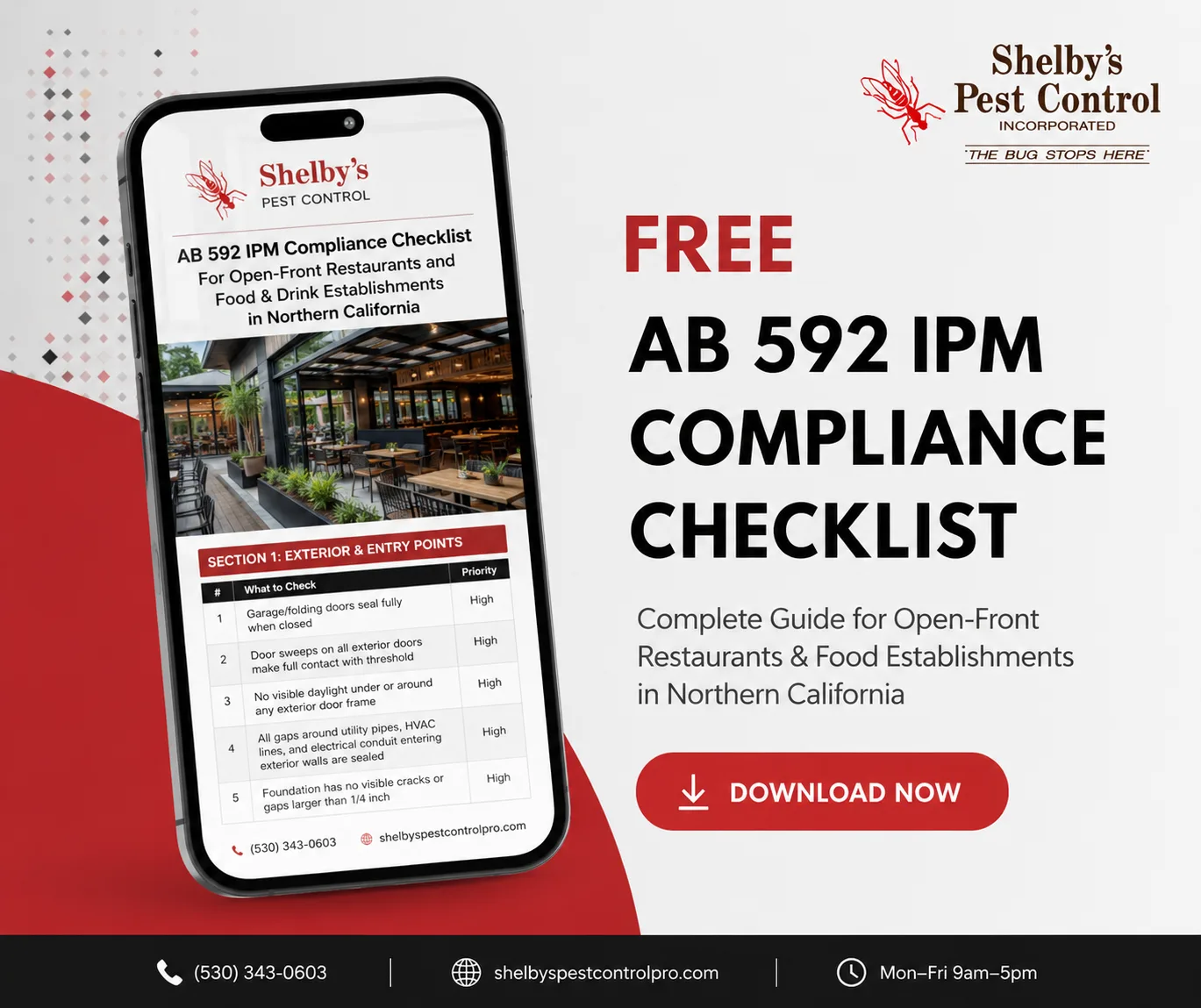
Whether you’re preparing for an upcoming inspection, opening an open-front concept, or reviewing your current IPM documentation, this checklist is designed to help you stay proactive and organized.
Need help creating or reviewing your AB 592 plan? Shelby’s Pest Control offers compliance assessments, exclusion work, monitoring programs, documentation support, and ongoing pest management services tailored for Northern California restaurants and food facilities.
If your restaurant has an open-front configuration and you do not have an approved AB 592 plan on file, the time to start is now, not the week before your next inspection. County review takes time and you cannot legally operate the configuration without approval.

Running a restaurant? Forward this to your GM or operations manager. The AB 592 requirement is new enough that most open-front operators in Northern California have not seen it yet
It depends on the configuration. The law targets open-front setups where the interior of the food facility is directly open to outside air during service. A fully covered, walled patio with separate ventilation is typically different from a folding-front interior that opens to the street. If you are unsure whether your specific setup triggers the requirement, contact your county Environmental Health division for a determination before you operate.
Not necessarily. AB 592 applies to bona fide public eating places — full-service restaurants that regularly serve complete meals. A bar or establishment operating under limited food preparation that only serves sandwiches or salads does not qualify for the open-front exemption under AB 592, and is also not subject to the IPM plan requirement. Standard CalCode pest control compliance applies to all food facilities regardless. If you are unsure how your operation is classified, your county Environmental Health division can confirm.
From initial assessment to approval typically runs two to four weeks. Butte County and Shasta County Environmental Health divisions both have review queues, and timing can vary depending on the time of year. Give yourself at least a month of lead time before you plan to begin or resume an open-front configuration.
Operating an open-front configuration without an approved plan is a CalCode violation. If an inspector observes the configuration and there is no plan on file, you are subject to the same major violation and permit suspension process as other imminent health hazard findings. You close until compliance is achieved and a plan is approved.
Standard pest control service addresses pest activity as it occurs or on a scheduled preventive basis. An AB 592 IPM plan is a documented program that describes your prevention strategy, monitoring setup, and response protocols specific to the risks created by your open-front configuration. You can have standard pest control service without an IPM plan, but for AB 592 compliance, you need both the plan and the documented service to back it up.
Not automatically, but you do need to update your plan to reflect the new provider. The plan must accurately describe your current pest management program, including who your licensed pest control operator is. Submitting an outdated plan with a provider who no longer services your facility creates a documentation gap that could become a compliance issue during an inspection.
Shelby’s Pest Control helps Northern California property owners identify risk areas before they turn into costly infestations, violations, or tenant complaints.Shelby’s offers fast, local scheduling and programs designed specifically for Northern California businesses.
📍 Serving Chico, Butte County, Tehama, Shasta, Yuba, and surrounding areas
We use cookies to improve your experience on our site. By using our site, you consent to cookies.
Manage your cookie preferences below:
Essential cookies enable basic functions and are necessary for the proper function of the website.
These cookies are needed for adding comments on this website.
Statistics cookies collect information anonymously. This information helps us understand how visitors use our website.
Google Analytics is a powerful tool that tracks and analyzes website traffic for informed marketing decisions.
Service URL: policies.google.com (opens in a new window)
Google reCAPTCHA helps protect websites from spam and abuse by verifying user interactions through challenges.
You can find more information in our Cookie Policy and Privacy Policy.